





INTERVIEW
Kojo Talks Doubles
Trini Realness @ The Tank
Fam Drama And Broadway
by Vinik Ernest
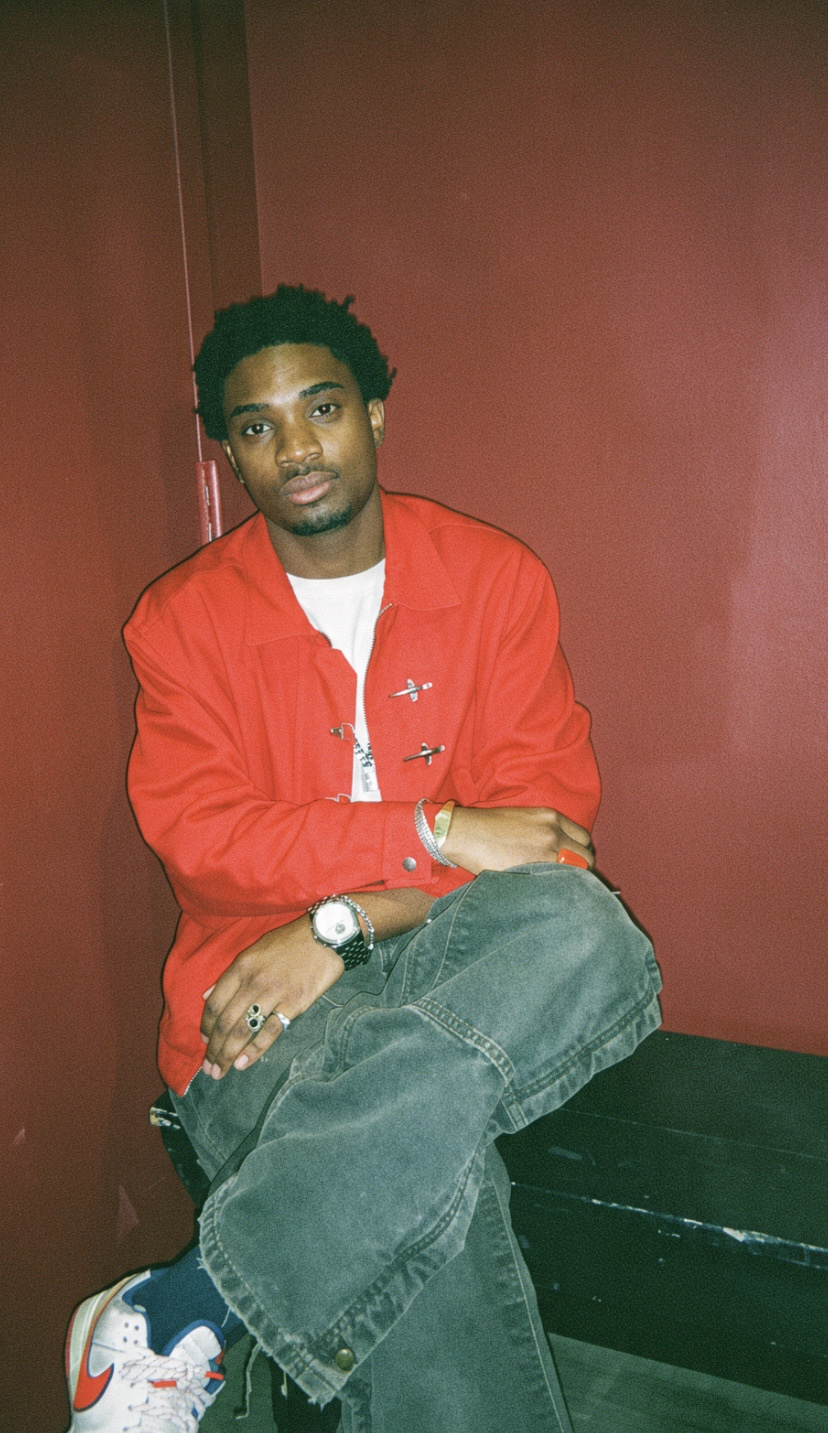
Photography by PALMTREE

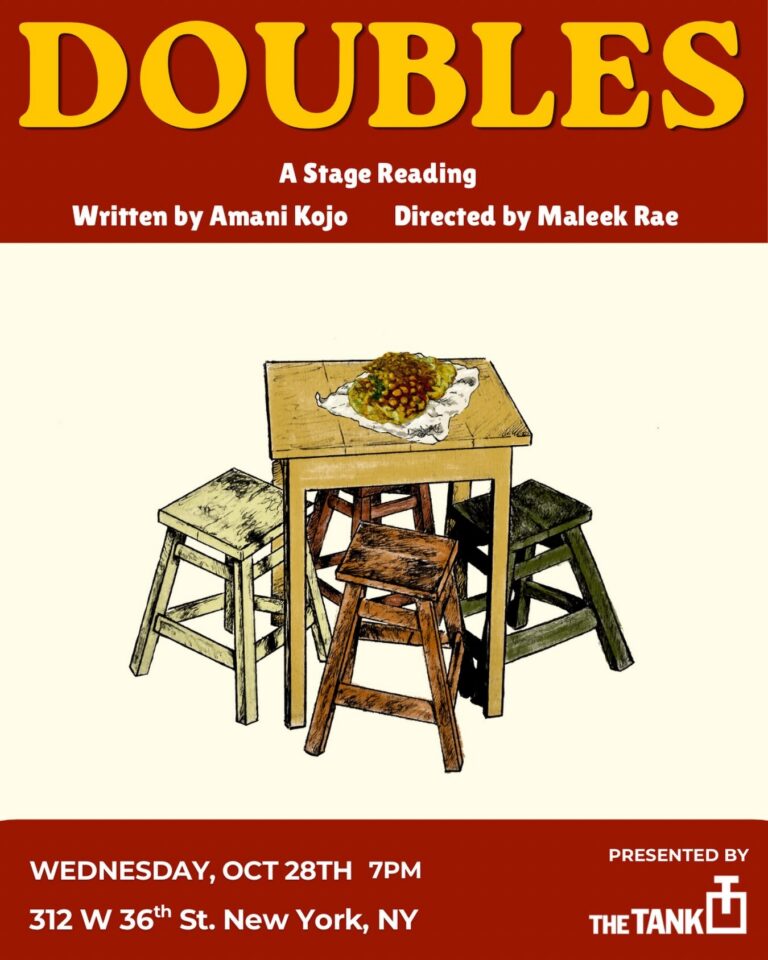
At the October 28, 2026 reading of Doubles at The Tank, Amani Kojo brought us into a Trinidadian family’s Crown Heights doubles shop. Directed by Maleek Rae, the reading explored the pressures of keeping a business, a family and a connection to home alive. It also had the ENTIRE crowd laughing including myself.
I caught up with Kojo to talk about the food behind the title, the dreams and disagreements inside this family, and what happens when a parent’s greatest gift feels different to their child.
Vinik Ernest: First of all, congratulations. The reading was amazing. I remember telling you I was feeling low, but Doubles really put a smile on my face. It was hilarious, but so real and touching as well. Why doubles? What made that food the starting point for the story?
Amani Kojo: I can vividly remember the first time I had a memory or a connection to my Trinidadian heritage, and it was through eating doubles.
As a kid, I remember my mom taking the family to a doubles shop after work; she owned her own business. I remember my mom being like, “You’ve got to have doubles. You’ve got to try doubles.” I remember trying it and being like, “Oh my God, I like this. Doubles is dope.”
In comparison to a lot of other things that have come out of Trinidad, doubles has this in-between space of being almost so popular and almost in the cut at the same time. It’s like, you’ve got to know to know. But if you’ve interacted with the culture, you’ve had doubles. People from the country know how much it’s a cornerstone for so many things, like breakfast. Sometimes that’s the first thing they eat.
When I went to Trinidad for the first time, I went to Carnival as a kid. My dad had taken me there. Before we would go anywhere, the first place we were going was the doubles shop, which was on the side of the road.
That goes to show that culture is also passed through food. A lot of times people look at the music, the flags and the history, but food is such a big cornerstone of that, and it really does travel. Food is a mode of transportation of culture. That was really why I titled it Doubles.
VE: I didn’t know your mother was a business owner. Was she the inspiration for the character Anne-Marie?
AK: Not necessarily. Anne-Marie is a combination of a lot of different people in my life, a lot of different Trinidadian women I know.
Anne-Marie was named after my aunt who passed. Anne-Marie and Junior are named after my mom’s eldest siblings: her eldest brother is Junior, and her eldest sister is Anne-Marie.
Some of it can be placed with my mother, but I wouldn’t say she’s the totality of that. My relationship with her is nothing similar to Arthur’s dynamic with his mother.
VE: I said it before but doubles was so funny. You had the WHOLE audience in stitches in The Tank. Would you consider this a drama-comedy?
AK: I was only thinking that, because when you’re writing it, you’re not really thinking about the genre. You’re just writing. I would put it in that dramedy section right now.
These are very serious circumstances. I think Trinidadians have a natural way of being funny that we sometimes don’t get the credit for. Their delivery is Gold. Even the sayings are very funny. The life they’re living is a bit comedic because there’s so much tension going on.
It’s not a comedy in that way, for people to just come and be entertained. It’s a dramedy because these are real-life circumstances. To be able to let go of that, these people have to be able to laugh through it.
VE: Yess I love me a trini and Junior was hilarious! One of my favorite characters. Can you explain some of the serious aspects of Doubles and why they’re important?
AK: Firstly, this is a play that’s imparting a conversation about displacement, and how it looks on different people. Before you get into the conversation about whose culture this is, you have to look at the fact that this is a family, or a group of people, who migrated to a city or a country. They had high hopes, and surely they were disappointed. With that disappointment comes hardship.
That’s important right now, given that we’re dealing with a time where migration and all these things are not celebrated. You’re not celebrated for being other. Quite frankly, the conversation of otherness has never been something that was celebrated at all. You get to humanize these people outside of what people think of them.
That’s when we start getting into the culture of it. The Character John has a reference where he goes, “I’m not really feeling for Jamaican food today.” when referring to trini food and It’s a big miscommunication that happens across diasporas and cultures. Sometimes when you migrate to a country such as the United States, people put everything into one bubble. With that, there’s a sense of erasure and dehumanization.
You might say, “It’s not that big of a deal,” but if I’m erasing someone’s culture, even in how I refer to them or see them, that’s a form of violence.
Number two, if you’re able to disconnect from the racial aspects of the play, it’s also talking to the working person, the working class. Junior is a big embodiment of that: someone who has spent so much time toiling and toiling, and at the end of all these years, he’s still not respected.
We’re told that we need to work our way up to places, but when we get there, sometimes it isn’t worth it, especially if you’re working for another person who’s worried about their bottom line.
Lastly, it’s important not just to the artist, but to the dreamer. Arthur is an embodiment of what it means to be a dreamer in a world that tells you no. The biggest no you’re probably going to feel isn’t from some executive. You’re going to feel it from the person closest to you.
What does it look like when I’m told no so many times, and that pain is still making me want to dream more? How can I dream outside of what I know already? That’s a bigger conversation, not only for artists, but for people who are chasing something they want.
VE: That’s powerful. I was going to ask about Arthur’s dreams and his dynamic with his family. The shop is like a lifeline and a burden at the same time. What do you think gets left out when people talk about a neighborhood changing, and what did you want to bring into that conversation with Doubles?
AK: A lot of times, when we get into the gentrification talk, it’s, “It’s affecting the neighborhood. People are going to have to move out.” What’s often missed is: what does it cost these people’s lives?
We’re in a rapidly changing environment, not just in New York City, but around the country, in regards to affordability. People talk about displacement and gentrification without thinking about the actual circumstances of the people who live there.
When we see erasure happen, we often have to go back to history books to discover and learn these things. Sometimes we lose the firsthand account. The big thing about gentrification is that it doesn’t leave history behind. It actually takes it away.
If my first time interacting with Crown Heights, Brooklyn, is with coffee shops and cafes, I’m going to think about Crown Heights as coffee shops and cafes. There’s a difference when you renew a space but leave its history, so people can go back and say, “This was a landmark. This person created this for the community here.”
But in spaces where people are getting displaced, you just see nothing. It’s just new. You get a Wonder on the block, or a Whole Foods, or a Trader Joe’s. These are like Trojan horses of erasure, and people are very unaware of it.
VE: Going back to Arthur and his mother, what does keeping that shop and the culture alive mean to the parents that it might not mean to their children?
AK: If you think about how hard it is just to be an entrepreneur, outside of the culture, being an entrepreneur is very hard. Being a brick-and-mortar business owner is even harder. Then stack that with the fact that someone is coming and starting all over again. You put those things together, some time goes on, and they build something. There’s a heart that goes behind it.
A big conversation and friction in the reading is that this is also Anne-Marie’s gifts made manifest. She would like to pass that on to her child. That’s the biggest gift you can give somebody: all the work you’ve put in to get to that point.
For Anne-Marie, and the people she represents who come here and start over and want to pass something on, it represents all the work they do. It’s the biggest gift you can physically give to another. It’s the years, the time.
She’s trying to protect Arthur from her own fears. She’s also trying to hand him something she knows in her heart is worth so much, because she’s seen how her work has been able to help so much.
VE: I’ve got chills. It’s so layered. I think Arthur and his mom can learn things from each other. I want to talk about superstition, because Anne-Marie talks about dreaming of fishes and traditions passed from her great-grandmother to her grandmother, to her mother, to her. What can you share about that?
AK: When you research Trinidad and Tobago and how much culture is baked into that little country, you realize how many different spiritual understandings there are. Trinidadian culture is very superstitious.
VE: Facts! I feel the Caribbean in general is very superstitious.
AK: Yes. A big thing when I was writing Doubles was that the superstitions almost come true. That’s the haunting thing about the spiritual undertone of the play: the words these characters are saying are manifesting. If you didn’t catch what they said, it happens later.
If “watch what you say” was a real thing, Caribbean people embody that. Even when Anne-Marie is telling that story about a spirit coming, I can’t tell you how many stories I’ve heard from different Caribbean people talking about, “This thing came to me.”
A big recurring theme in the play is dreams and visions. A lot of times you’ll hear people say, “I had a dream, and this happened.” The doubles shop itself is also held up by a spiritual presence. Each of the characters interacting with the space is also interacting with conflicting visions and presences of their own.
VE: I love that now let’s do some fun questions. We’re Harlem School of the Arts twins, which you know I love. What’s one lesson or habit from there that still shows up in your work today?
AK: I had a few mentors: Lisa Arrindell, Amanda McDowall and Tracy Jack. The big thing I learned was to toil. Be specific and toil.
When I was there, I was in my adolescence, probably around sixteen or seventeen. I was very ambitious about what I wanted to do as an actor and an artist. Having adults around embodying that as well, pushing me forward and saying, “You’ve got to do this”—the biggest thing was that they told me to believe in myself.
VE: That’s important, especially for young Black people. How did you get connected with the school?
KOJO: I think I was doing a school play, and somebody said, “You should go and check out this program in Harlem. They have this whole pre-conservatory there.” I went, and they granted me this huge scholarship to train. It was all history from then.
VE: I want to talk about the cast. How did you go about choosing them?
AK: Being transparent about the process, a big thing for me at this stage was finding two things: somebody who knew the Trinidadian accent already, and somebody who had some previous acting experience.
The Trinidadian accent is a big deal. In my text, I have a thing that says “oui,” like the French “oui,” meaning yes. Sometimes you’ll catch Trinidadians saying it when they’re really upset. That’s because of the influence of the French at that time.
We had such a short rehearsal time. I couldn’t afford an actor the time to work on an accent, so that led to our casting decisions. I got recommendations from different actors and spoke to them on the phone. I think spirit guided me to the right set of people.
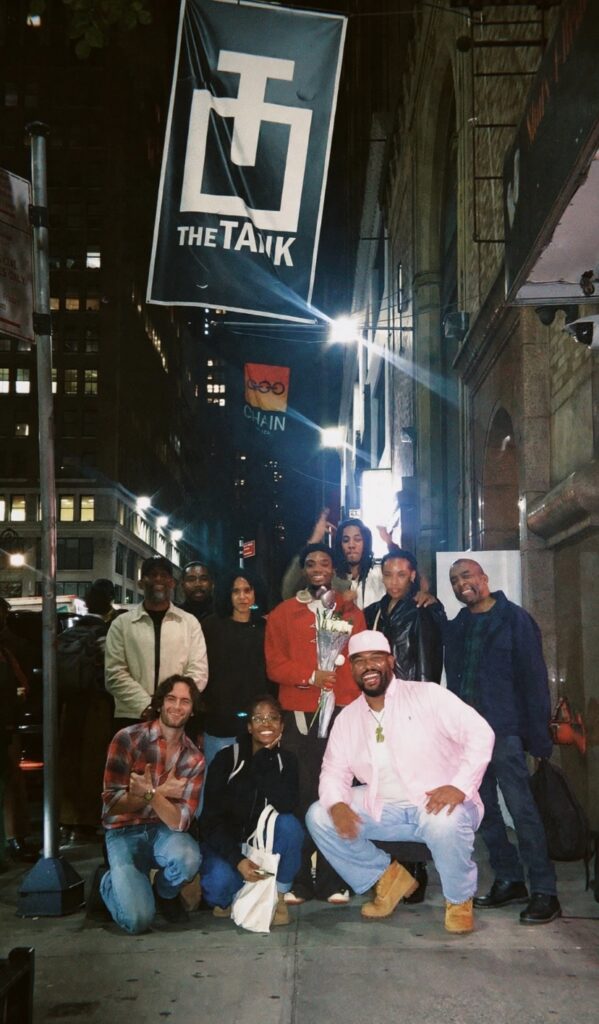
VE: Can you name the performers and who they play?
AK: Brian Richardson plays Junior, and Issa-Malik Bernard plays CD Man,
VE: Oh yesss CD Man had me cracking up with all his singing! Good taste in music i’ll give’em that lol
AK: I know, right? Then there’s Efua Hayfron-Benjamin as Samantha; Italy Ja’rae Lee reading stage directions; Jacob Dedona as John and Ralph; Alyssa Carter as Anne-Marie; and Khalid Hamid as the TV Pastor.
VE: Loved the whole cast, such a talented bunch and Alyssa’s accent was flawless. I had to give her her props after the show.
Ralph was so problematic, but in the funniest way.
AK: HAHAHA
VE: Everything that came out of his mouth was a mess.
AK: Yeah it was crazy (Shuckles)
VE: Another favorite was Samantha, Arthur’s sister. Their relationship is so interesting.
I noticed there’s this desire for a connection, but it never really happens. Can you share more about that?
AK: Arthur and Samantha’s circumstances are very different. Samantha had gone down to Trinidad with her dad to watch him make this painting. She was in America at a certain point, and because of the embassy and all those things, she wasn’t able to come back to New York.
Her dynamic is that she almost was going to live the same life as Arthur, and she didn’t. The undertone is that she’s resentful, not toward him, but toward the circumstances. But he is the target of that.
Arthur really didn’t know his sister. It’s a bit of an “ignorance is bliss” thing. He’s also unaware of the dynamic where you’re supposed to respect your older sister. But he didn’t grow up with her. It’s almost, “How can you expect me to just give you respect because you’re my sister? I don’t know you.”
Both of them don’t know each other. They don’t know each other’s perspective of the world or how they relate to each other. That’s why their dynamic is so stark. I feel like that’s resonant for a lot of different people in the Caribbean. You don’t know each other, but there’s a feeling of, “Damn, it would have been nice if I had a sister or a brother.”
VE: I’d love to see how that relationship evolves. I see big things for Doubles. Be honest: which character would you least want to be stuck working with on a shift?
AK: HAHAHHAH John
VE: Felt that lol, why?
AK: Why? John, if you catch some of his lines he is very indulged in himself and i think if i was on shift id hate to work with John because He doesn’t care about anything but himself and im just like c’mon man like
VE: John is something else. Problematic, but needed? In the realm of doubles at least. That said, where do you want Doubles to go next?
AK: Broadway! For right now I want to be able to workshop the play some more, to see how it lifts up and gets to be heard on different ears cause I definitely have some changes I’m making to it as well.
VE: What are you working on right now?
AK: I’m working on a beautiful opera, Adia & Clora Snatch Joy, at the Huntington Theatre in Boston, written by Mfoniso Udofia. Beautiful, amazing playwright. Definitely do some research on her.
VE: I will. Amani, thank you so much for taking the time. I can’t wait to share this.